
Facing criminal charges in Pakistan can be a profoundly isolating and high-stakes ordeal. A single criminal allegation—whether well-founded or completely malicious—can jeopardize your freedom, ruin your professional reputation, and destabilize your family. When the state brings its full machinery against you, you cannot afford passive or purely administrative legal representation. You need a resolute, battle-tested criminal defense team that understands how to dismantle the prosecution’s case from day one.
Based in Lahore, Punjab, our law firm provides aggressive, strategically calculated criminal defense representation. While our primary footprint is within the Sessions Courts of Lahore and the Lahore High Court, we actively manage high-stakes criminal matters for clients throughout Punjab and across Pakistan. We do not wait for the prosecution to dictate the tempo of your case; we intervene early, challenge procedural anomalies, and force the state to prove every single element of their allegation beyond any shadow of double-meaning or doubt.
Navigating the Code of Criminal Procedure (CrPC) in Punjab
Criminal litigation in Pakistan is strictly governed by the Code of Criminal Procedure, 1898 (CrPC), read alongside the Pakistan Penal Code, 1860 (PPC). The legal framework is complex, and procedural lapses by law enforcement agencies are incredibly common. An exceptional defense does not simply argue innocence; it aggressively targets these procedural failures to compromise the integrity of the state’s case.
From the registration of a First Information Report (FIR) under Section 154 CrPC to the submission of the police investigation report (Challan) under Section 173 CrPC, every step requires eagle-eyed scrutiny. Our defense methodology relies on deep technical mastery of the CrPC. We hold police investigators, complainants, and state prosecutors strictly accountable to the letters of the law, ensuring that your constitutional rights to a fair trial and due process are preserved without compromise.
Pre-Arrest Bail (Bail Before Arrest) Under Section 498 CrPC
When you become aware of a criminal accusation or an actively registered FIR against you, your absolute priority must be the preservation of your physical liberty. In Pakistan, the police possess sweeping powers of arrest. To prevent the humiliation, psychological trauma, and tactical disadvantage of immediate police custody, we immediately move the courts for Pre-Arrest Bail under Section 498 of the CrPC.
Protecting You from Malicious Prosecution
Pre-arrest bail is an extraordinary judicial remedy. The superior courts of Pakistan have established that pre-arrest bail is designed specifically to protect citizens against malafide (bad faith) intentions, ulterior motives, and malicious orchestration by opponents or corrupt elements within law enforcement.
When we represent you in a petition for anticipatory or pre-arrest bail before the Court of Sessions or the Lahore High Court, our arguments focus on demonstrating:
Absence of Prima Facie Case: Proving that the allegations on the face of the FIR lack logical cohesion, corroborative evidence, or physical possibility.
Malafide Intentions: Exposing the underlying animosity, business rivalries, or personal disputes that motivated the complainant to weaponize the criminal justice system against you.
Irreparable Loss to Reputation: Demonstrating to the judge that allowing the police to arrest you prior to a thorough judicial assessment would cause permanent, unjustifiable damage to your social and professional standing.
Our firm acts with extreme urgency. The moment an FIR is registered or threatened, our team prepares the necessary documentation, files the petition, and secures ad-interim (interim) pre-arrest bail, ensuring you can walk into the courtroom and back out to your home safely while we fight the underlying charges.
Post-Arrest Bail Under Section 497 CrPC
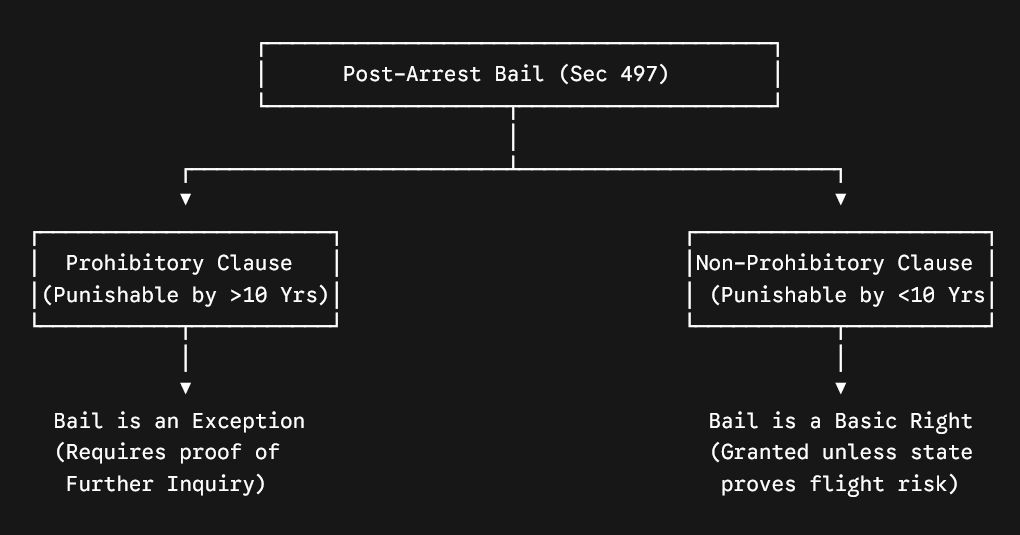
If an arrest has already occurred, the legal battle shifts entirely to securing your immediate release from judicial or police custody. Post-Arrest Bail is governed by Section 497 of the CrPC, and it divides criminal offenses into two distinct legal categories: the prohibitory clause and the non-prohibitory clause.
Offenses Falling Outside the Prohibitory Clause
If the offense you or your loved one is accused of carries a maximum punishment of less than ten years of imprisonment, it falls outside the prohibitory clause. In these matters, the superior courts of Pakistan have repeatedly ruled that the grant of post-arrest bail is a standard rule, and its refusal is an extreme exception. We aggressively enforce this principle, arguing that bail cannot be used as a form of premature punishment before a trial has concluded.
Offenses Falling Within the Prohibitory Clause
For more severe allegations (where the statutory punishment is death, imprisonment for life, or imprisonment extending up to ten years), bail is restricted. However, our defense strategy focuses on discovering the legal cracks that allow judges to exercise judicial discretion in your favor. We build robust arguments around:
- The Rule of Further Inquiry: Demonstrating that the prosecution’s current evidence is contradictory, vague, or relies on untrustworthy eyewitness accounts, thereby requiring “further inquiry” into your guilt under Section 497(2) CrPC.
- Statutory Delay: If your trial has failed to conclude within a specific statutory window through no fault of your own (e.g., one year for minor offenses, two years for offenses punishable by death), you gain a statutory right to bail, regardless of the severity of the charge.
- Special Exceptions: Utilizing statutory protections for women, minors, the elderly, or individuals suffering from severe sickness or physical infirmities that cannot be properly treated within a prison facility.
Criminal Trial Advocacy: Defending Your Rights from FIR to Verdict
The criminal trial is the ultimate crucible of the legal system. It is where theories are discarded, and only hard, admissible evidence remains. If a case cannot be resolved or dismissed during the bail stages, our trial team prepares for absolute litigation.
A criminal trial in Pakistan moves through rigid, highly formal stages under the CrPC, and our firm maintains command over each phase:
1. The Investigation and Challan Review (Section 173 CrPC)
After an FIR is registered, the police are legally required to compile their findings into a final report under Section 173 CrPC, commonly known as the Challan. We do not accept police findings at face value. Our lawyers conduct an independent, forensic review of the Challan, identifying missing physical evidence, unexamined call data records (CDRs), contaminated crime scenes, and inconsistencies in witness timelines.
2. Framing of Charges (Formal Indictment)
The trial officially begins when the court reads the specific charges to the accused. We carefully analyze the indictment to ensure the prosecution is not overcharging or applying irrelevant sections of the Pakistan Penal Code to inflate the gravity of the case.
3. Prosecution Evidence & Rigorous Cross-Examination
This is where standard legal representation is separated from elite trial advocacy. The state will call its witnesses, including the complainant, alleged eye-witnesses, and medical or forensic experts. Our cross-examination style is methodical, unyielding, and surgically precise. We focus on exposing:
Pre-meditated collusion between witnesses.
Discrepancies between the initial oral statement, the written FIR, and the subsequent police statements recorded under Section 161 CrPC.
Forensic and medical anomalies (e.g., where post-mortem or medical examinations contradict the alleged time of an assault or weapon trajectory).
4. Statement of the Accused (Section 342 CrPC)
Near the conclusion of the trial, the accused is given an opportunity to answer questions presented directly by the court under Section 342 CrPC. We meticulously prepare our clients for this stage, ensuring that your formal answers perfectly align with our overarching defense strategy and close any remaining loopholes the prosecution might try to exploit.
5. Final Arguments & Judgment
In the final phase of the trial, we deliver structured, persuasive closing arguments, backed by exhaustive case law from the Supreme Court of Pakistan and the High Courts. We piece together the broken elements of the prosecution’s case to demonstrate a comprehensive lack of proof, forcing the court to return a verdict of acquittal.
Additional Core Criminal Law Services
Our defense capabilities extend across all major avenues of the criminal justice system in Pakistan, protecting our clients from systemic vulnerabilities:
Quashment of FIRs (Section 561-A CrPC)
When a criminal case is transparently fraudulent, fabricated, or constitutes an abuse of the judicial process, we do not wait for a prolonged trial to run its course. We file Constitutional Petitions under Section 561-A of the CrPC before the Lahore High Court seeking the outright quashment of the FIR. If we can prove that the allegations do not constitute a legal offense or that the criminal machinery is being misused to settle a purely civil or commercial dispute, the High Court has the power to strike down the case entirely.
Criminal Appeals and Revisions
If a lower court has handed down an unjust conviction or an erroneous sentence, the battle is far from over. The CrPC grants the right to appeal convictions to higher judicial forums. We handle criminal appeals before the High Courts and the Supreme Court of Pakistan, reviewing the trial record with technical precision to show where the trial judge misapplied the law, ignored exculpatory evidence, or allowed procedural illegalities to taint the verdict.
Why Choose Our Criminal Defense Team?
We do not run a passive practice. Our reputation is built on an aggressive, highly strategic approach to criminal defense that prioritizes the client’s liberty and piece of mind above all else.
Command Over Local Jurisdictions: While we handle critical matters all over Pakistan, our deep familiarity with the judicial ecosystem of Lahore and wider Punjab gives our clients a distinct, grounded advantage.
Proactive Procedural Intervention: We do not simply respond to police actions; we anticipate them. By deploying early interventions like pre-arrest bail and High Court structural challenges, we frequently neutralize cases before they can cause catastrophic personal damage.
Analytical Precision: We combine traditional, unyielding courtroom litigation with contemporary investigative tools, utilizing digital forensics, geo-fencing data, and expert medical reviews to shatter the state’s narrative.
If you, your family member, or your business enterprise is facing a criminal allegation, investigation, or an active FIR in Pakistan, time is your most critical asset. Contact our office immediately to consult with a dedicated, authoritative criminal defense attorney who will stand between you and the state to protect your future.
Frequently Asked Questions Regarding Criminal Law in Pakistan
Q: Can the police arrest me if I have already been granted interim pre-arrest bail? A: No. Once a competent court grants you ad-interim pre-arrest bail, you cannot be arrested by the police in that specific FIR, provided you regularly attend the scheduled court hearings and join the police investigation as directed by the judge. The police can only arrest you if the court formally dismisses your bail petition at a later final hearing.
Q: What is the difference between a Cognizable and a Non-Cognizable offense? A: Under the CrPC, a cognizable offense is a serious crime where the police have the legal authority to arrest a suspect immediately without needing a warrant from a magistrate (e.g., dacoity, murder, theft). In non-cognizable offenses, the police cannot make an arrest or initiate an official investigation without explicit, written authorization from a magistrate.
Q: Can a criminal case be settled out of court through a compromise in Pakistan? A: It depends entirely on whether the offense is classified as “compoundable” or “non-compoundable” under Section 345 of the CrPC. Compoundable offenses (such as certain financial disputes, minor assaults, or defamation) can be legally settled if the complainant signs a formal compromise agreement. Non-compoundable offenses (such as major dacoities, state security matters, or severe corporate fraud) cannot be legally settled privately, and the state will continue the prosecution regardless of the complainant’s wishes.